
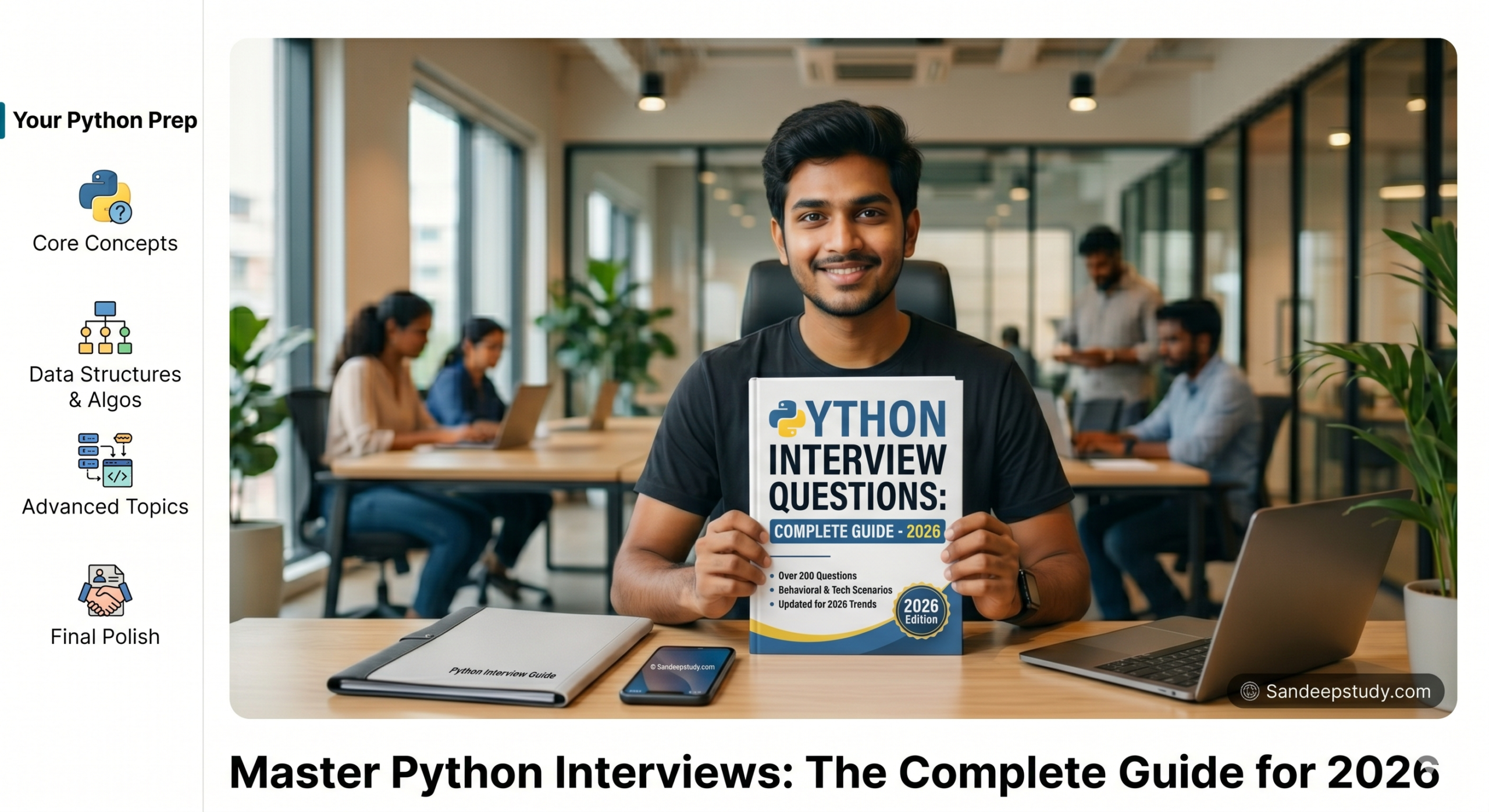
Python Interview Questions — ye topic 2026 mein har fresher aur placement student ke liye sabse zaroori topic ban gaya hai. Chahe tu web development mein jaana chahta ho, data science mein, automation mein, ya AI/ML mein — Python har jagah hai, aur isliye Python Interview Questions almost har company ke technical round mein aate hain.
Agar tu BTech ka student hai ya freshers placement ki taiyaari kar raha hai, toh ye article tere liye hi likha gaya hai. Main ek senior developer ki tarah tujhe Python Interview Questions ke saath saath unke proper answers, real-life scenarios, code examples with comments, aur interview-ready scripts samjhaunga — bilkul simple Hinglish mein.
Python Interview Questions ki taiyaari karna mushkil nahi hai — bas sahi direction chahiye. Chalte hain shuru se, zero se, ek ek concept clearly.
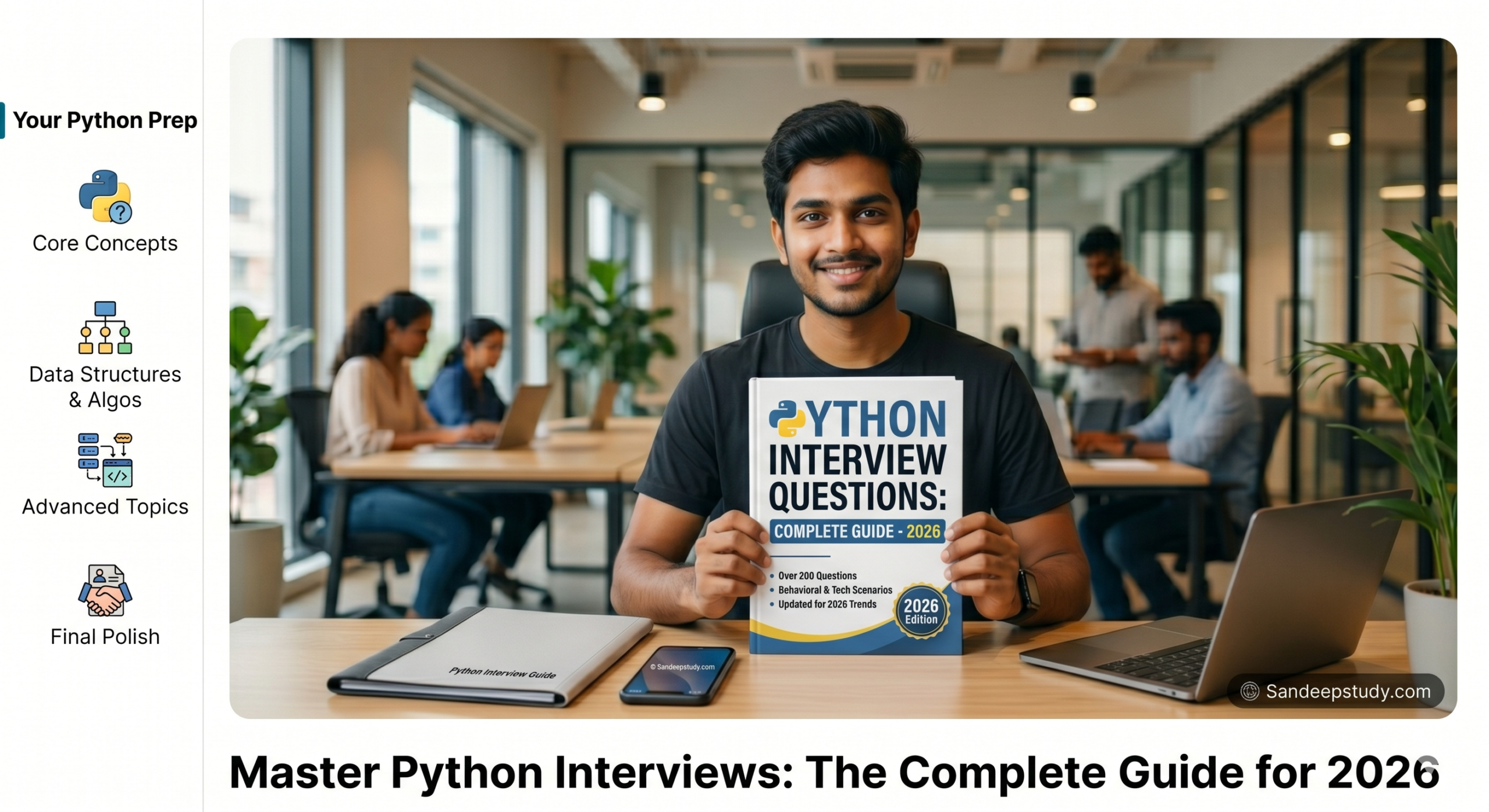
Python Interview Questions — Python Kya Hai Simple Definition Mein
Python Interview Questions mein sabse pehla aur sabse common question yahi hota hai — Python kya hai. Isliye pehle ye clearly samjho aur ek solid answer ready rakho.
Python ek high-level, interpreted, general-purpose programming language hai jo simple aur readable syntax ke liye famous hai. 1991 mein Guido van Rossum ne banaya tha. Python ka design philosophy ye hai ki code padhna aur likhna utna hi easy hona chahiye jitna English padhna hota hai.
Python sirf ek language nahi hai — ye ek ecosystem hai. Web development ke liye Django aur Flask, Data Science ke liye NumPy aur Pandas, Machine Learning ke liye TensorFlow aur Scikit-learn — sab Python pe chalta hai.
Interview mein exactly yahi bol:
Yes sir, Python ek high-level, interpreted, general-purpose programming language hai jo easy syntax aur readability ke liye famous hai. Python dynamically typed hai — matlab variable ka type runtime pe decide hota hai. Python ke strong points hain — kam code mein zyada kaam, huge standard library, aur multiple domains mein use — web development, automation, data science, AI, aur machine learning. Isliye 2026 mein Python Interview Questions almost har company ke technical round mein include hote hain.
Python Interview Questions — 2026 Job Market Mein Kyun Important Hai
Python Interview Questions ki taiyaari kyun karni chahiye — ye samajhna zaroori hai toh seriously isko lete ho. 2026 mein Python duniya ki sabse popular programming language hai — TIOBE Index aur Stack Overflow Developer Survey dono mein top position pe hai.
- Google, Amazon, Netflix, Instagram — sab companies internally Python use karti hain
- Data Science aur AI/ML roles mein Python knowledge compulsory hai
- Automation engineers ke liye Python primary language hai
- Backend web development mein Django aur Flask ke through Python heavy use hoti hai
- Freshers ke liye 3 LPA se 8 LPA range mein Python developer roles available hain
- Off-campus placements mein Python Interview Questions pehle filter mein aate hain
- Java developer bhi hoga toh scripting aur automation ke liye Python ka knowledge bonus hai
Python Interview Questions ki proper taiyaari karo — aur ye ek baar karo sahi se. Baar baar phir se start karne ki zaroorat nahi padegi.
Python Interview Questions — Real Life Scenario Examples
Python Interview Questions tab better samajh aate hain jab real-life mein dekhte hain ki Python actually kahan use hoti hai.
Scenario 1 — Instagram aur Python Backend
Instagram — jo aaj duniya ke most used social media platforms mein se ek hai — originally Django framework pe bana tha jo Python-based hai. Instagram ka backend Python use karta hai kyunki fast development possible hai, codebase manageable rehta hai, aur Python ki libraries se complex features quickly implement ho jaate hain. Jab tu Instagram pe photo upload karta hai, comment karta hai, ya story dekhta hai — Python backend mein kaam kar raha hota hai.
Scenario 2 — Netflix aur Python Automation
Netflix apne data pipeline automation, A/B testing, aur recommendation system mein Python heavily use karta hai. Jab Netflix tujhe “You might also like” section dikhata hai — Python ke machine learning scripts background mein run kar rahe hote hain jo teri watching history analyze karte hain aur relevant content suggest karte hain.
Scenario 3 — Company Excel Report Automation
Ek company mein HR department roz manually Excel mein attendance report banata tha — 2 ghante lagte the. Ek Python developer ne ek chhota sa script likha — openpyxl library use karke — jo automatically database se data read karta hai, Excel file generate karta hai, aur email pe send karta hai. Kaam jo 2 ghante mein hota tha — wo ab 2 second mein hota hai. Ye Python automation ka real power hai.
Scenario 4 — Flipkart aur Web Scraping
Market research companies Python ka use karke competitor ki website se pricing data scrape karti hain — BeautifulSoup aur Scrapy libraries use karke. Flipkart aur Amazon ke prices compare karne wale tools bhi Python se bane hain. Ye ethical aur legal use case mein ek common Python application hai.
Python Interview Questions — Most Asked Questions with Answers
Python Interview Questions mein ye questions almost har company mein poochhe jaate hain. Har ek ka proper answer taiyaar kar ke rakho:
Question 1 — Python kya hai aur kyu use hoti hai?
Yes sir, Python ek high-level, interpreted, general-purpose programming language hai. Isko isliye use karte hain kyunki syntax bahut simple aur readable hai — beginner bhi jaldi seekh sakta hai. Python dynamically typed hai, object-oriented bhi hai aur functional programming bhi support karta hai. Use cases hain — web development Django aur Flask se, data analysis NumPy aur Pandas se, automation scripts, machine learning TensorFlow se, aur scripting tasks. Python ki sabse badi strength hai uski huge standard library aur active open-source community.
Question 2 — Python mein List aur Tuple mein kya difference hai?
Yes sir, List aur Tuple dono sequence data structures hain lekin inke beech kuch key differences hain. List mutable hoti hai — matlab create karne ke baad elements change, add, ya delete kiye ja sakte hain — square brackets mein define hoti hai. Tuple immutable hoti hai — ek baar create hone ke baad elements change nahi ho sakte — parentheses mein define hoti hai. Performance mein Tuple faster hoti hai kyunki immutable hai — Python internally optimize kar sakta hai. Tuple tab use karo jab data change nahi hona chahiye — jaise coordinates, database records. List tab use karo jab data dynamic ho.
| Feature | List | Tuple |
| Mutable hai? | Yes — change ho sakti hai | No — immutable hai |
| Syntax | Square brackets [ ] | Parentheses ( ) |
| Performance | Relatively slow | Faster than List |
| Memory | Zyada use karta hai | Kam use karta hai |
| Use case | Dynamic data | Fixed data, dictionary key |
| Methods | append, remove, sort etc. | count, index only |
Question 3 — Python mein Dictionary kya hota hai?
Yes sir, Python mein Dictionary ek mutable, unordered data structure hai jo key-value pairs store karta hai. Har key unique hoti hai aur ek value se associated hoti hai. Dictionary curly braces mein define hoti hai. Keys immutable honi chahiye — string, integer, ya tuple use kar sakte hain. Values kuch bhi ho sakti hain. Dictionary ka access O(1) average time mein hota hai — HashMap ki tarah internally hash table use karta hai. Real-life use case hai — user profile store karna jahan name, age, email keys hain aur unki respective values hain.
Question 4 — Python mein OOP kya hai? Main concepts kaunse hain?
Yes sir, OOP matlab Object Oriented Programming — ek programming paradigm hai jisme real-world entities ko classes aur objects ki tarah model karte hain. Python fully OOP support karta hai. Main concepts hain — Class jo ek blueprint hai, Object jo class ka instance hai, Encapsulation jo data hide karta hai, Inheritance jo ek class ki properties doosri class inherit kar sakti hai, Polymorphism jo same method alag alag classes mein alag behave karta hai, aur Abstraction jo complex implementation hide karke simple interface deta hai. Python mein OOP ka use karke maintainable aur reusable code likhte hain.
Question 5 — Python mein args aur kwargs kya hote hain?
Yes sir, star args aur double star kwargs Python mein variable length arguments handle karne ke liye use hote hain. Star args function ko multiple positional arguments accept karne deta hai — andar tuple ki tarah treat hote hain. Double star kwargs function ko multiple keyword arguments accept karne deta hai — andar dictionary ki tarah treat hote hain. Jab exactly kitne arguments aayenge pata nahi hota tab ye use karte hain — jaise general utility functions ya wrapper functions mein.
Question 6 — Python mein Lambda Function kya hai?
Yes sir, Lambda function Python mein ek anonymous function hota hai — matlab iska koi naam nahi hota. Lambda keyword se define hota hai aur ek hi line mein expression return karta hai — return keyword nahi likhna padta. Lambda tab use karte hain jab ek chhota simple function chahiye jo ek baar use hoga — jaise sort key define karna, filter ya map functions ke saath use karna. Lambda mein multiple arguments ho sakte hain lekin sirf ek expression hota hai. Complex logic ke liye regular def function better hota hai.
Question 7 — Python mein Exception Handling kya hai?
Yes sir, Exception Handling Python mein runtime errors ko gracefully handle karne ka mechanism hai — program crash hone se bachata hai. try block mein wo code likhte hain jo error de sakta hai. except block mein error handle karte hain. else block tab chaltha hai jab koi exception nahi aati. finally block hamesha chaltha hai — chahiye exception aaye ya na aaye — resources close karne ke liye use hota hai. Python mein built-in exceptions hain — ZeroDivisionError, FileNotFoundError, TypeError, ValueError, IndexError. Custom exceptions bhi define kar sakte hain Exception class inherit karke.
Question 8 — Python mein Decorator kya hota hai?
Yes sir, Decorator Python mein ek higher-order function hai jo kisi existing function ka behavior modify karta hai bina us function ka code change kiye. Decorator @ symbol se apply hota hai. Jaise logging decorator — kisi bhi function pe lagao aur wo automatically log karna shuru kar deta hai. Authentication decorator — check karo user logged in hai ya nahi — bina har function mein check likhne ke. Flask aur Django mein route decorators isi concept pe kaam karte hain. Decorator Design Pattern ka real-world implementation hai Python mein.
Question 9 — Python mein GIL kya hai?
Yes sir, GIL matlab Global Interpreter Lock — ye CPython interpreter mein ek mutex lock hai jo ensure karta hai ki ek time pe sirf ek thread Python bytecode execute kar sake — chahe multiple threads ho. Ye isliye exists karta hai kyunki CPython ka memory management thread-safe nahi hai bina GIL ke. GIL se CPU-bound multi-threaded programs slow ho sakte hain — truly parallel execute nahi kar sakte. Solution hai multiprocessing module use karna — alag processes mein kaam hota hai, har process ka apna GIL hota hai. IO-bound tasks mein threading still useful hai kyunki IO wait ke time pe GIL release hoti hai.
Question 10 — Python mein List Comprehension kya hai?
Yes sir, List Comprehension Python ka ek concise aur readable way hai naya list banane ka — existing list ya iterable se. Ek line mein loop aur condition dono likh sakte hain. Regular for loop se compare karo toh List Comprehension faster hoti hai kyunki internally optimized hai. Readability bhi better hai — ek line mein logic samajh aa jaata hai. Lekin bahut complex conditions ke liye regular loop zyada readable hota hai — List Comprehension ko simple rakho.
Python Interview Questions — Code Examples with Line by Line Comments
Python Interview Questions mein code likhna aur explain karna zaroori hota hai. Ye examples dekh — har line pe comment hai:
Code 1 — List vs Tuple vs Dictionary Demonstration
# ============================================================
# Python Interview Questions — Code Example 1
# Topic: List, Tuple, Dictionary — Differences with Examples
# Site: Sandeepstudy.com
# ============================================================

# LIST — mutable sequence — square brackets
# mutable matlab create karne ke baad change kar sakte hain
student_marks = [85, 92, 78, 95]  # marks ki list

# append() — list ke end mein element add karo
student_marks.append(88)
# student_marks ab hai: [85, 92, 78, 95, 88]

# index se element change karo — ye List mein possible hai
student_marks[0] = 90
# student_marks ab hai: [90, 92, 78, 95, 88]

print("List:", student_marks)
# Output: List: [90, 92, 78, 95, 88]

# TUPLE — immutable sequence — parentheses
# immutable matlab ek baar banane ke baad change nahi kar sakte
student_info = ("Rahul", 21, "CSE")
# ("Rahul", 21, "CSE") — naam, age, branch

# index se access karo — read only
print("Student Name:", student_info[0])
# Output: Student Name: Rahul

# student_info[0] = "Priya" — ye ERROR dega: TypeError: 'tuple' object does not support item assignment
# Tuple mein change nahi ho sakta — ye intentional hai

# DICTIONARY — key-value pairs — curly braces
# key se value access karo — O(1) average time
student_profile = {
    "name": "Sandeep",      # key: "name", value: "Sandeep"
    "age": 22,               # key: "age", value: 22
    "branch": "CSE",         # key: "branch", value: "CSE"
    "cgpa": 8.5              # key: "cgpa", value: 8.5
}

# key se value access karo
print("Name:", student_profile["name"])
# Output: Name: Sandeep

# get() method — safe access — key nahi hai toh None return karta hai
print("City:", student_profile.get("city", "Not Found"))
# Output: City: Not Found — "city" key nahi hai dictionary mein

# naya key-value add karo
student_profile["email"] = "sandeep@gmail.com"

# keys() — sab keys print karo
print("All Keys:", list(student_profile.keys()))
# Output: All Keys: ['name', 'age', 'branch', 'cgpa', 'email']

# values() — sab values print karo
print("All Values:", list(student_profile.values()))
Code 2 — Functions: Regular, Lambda, args kwargs
# ============================================================
# Python Interview Questions — Code Example 2
# Topic: Functions — Regular, Lambda, *args, **kwargs
# Site: Sandeepstudy.com
# ============================================================

# REGULAR FUNCTION — def keyword se define hota hai
# reusable block of code — baar baar call kar sakte hain
def calculate_grade(marks):
    # marks parameter — function ko input deta hai
    # if-elif-else se grade determine karo
    if marks >= 90:
        return "A+"      # return — value wapas bhejta hai caller ko
    elif marks >= 80:
        return "A"
    elif marks >= 70:
        return "B"
    else:
        return "C"

# function call karo — marks pass karo
grade = calculate_grade(85)
print("Grade:", grade)
# Output: Grade: A

# LAMBDA FUNCTION — anonymous function — ek line mein
# Regular function se compare karo:
# def add(a, b): return a + b
# Lambda equivalent:
add = lambda a, b: a + b
# 'add' variable mein lambda function store kiya
# lambda a, b — parameters
# a + b — expression jo return hogi

print("Sum:", add(10, 20))
# Output: Sum: 30

# Lambda real use — list sort karna custom key se
students = [("Rahul", 85), ("Priya", 92), ("Amit", 78)]
# students ko marks ke basis pe sort karo
# lambda x: x[1] — har tuple ka index 1 (marks) key hai
students.sort(key=lambda x: x[1], reverse=True)
print("Sorted by marks:", students)
# Output: Sorted by marks: [('Priya', 92), ('Rahul', 85), ('Amit', 78)]

# *args — variable positional arguments
# kitne bhi arguments pass kar sakte hain — tuple ki tarah milte hain
def calculate_total(*args):
    # args ek tuple hai — saare passed arguments ismein hain
    total = 0
    for num in args:       # har argument pe iterate karo
        total += num       # total mein add karo
    return total

print("Total:", calculate_total(10, 20, 30))        # 3 arguments
# Output: Total: 60
print("Total:", calculate_total(5, 15, 25, 35, 45)) # 5 arguments
# Output: Total: 125

# **kwargs — variable keyword arguments
# key=value format mein pass karo — dictionary ki tarah milte hain
def display_profile(**kwargs):
    # kwargs ek dictionary hai — saare key-value pairs ismein hain
    for key, value in kwargs.items():  # dictionary iterate karo
        print(f"{key}: {value}")       # f-string se format karo

display_profile(name="Sandeep", age=22, city="Delhi")
# Output:
# name: Sandeep
# age: 22
# city: Delhi
Code 3 — Exception Handling with Real Use Case
# ============================================================
# Python Interview Questions — Code Example 3
# Topic: Exception Handling — try except else finally
# Real-life: File read karna safely
# Site: Sandeepstudy.com
# ============================================================

# BASIC EXCEPTION HANDLING
def divide_numbers(a, b):

    try:
        # try block — wo code jo error de sakta hai
        result = a / b          # agar b = 0 toh ZeroDivisionError aayega
        print(f"{a} / {b} = {result}")

    except ZeroDivisionError:
        # specific exception handle karo — b = 0 ka case
        print("Error: Zero se divide nahi kar sakte")

    except TypeError:
        # type mismatch ka case — jaise string pass kar diya
        print("Error: Sirf numbers pass karo")

    else:
        # else block — tab chalta hai jab koi exception nahi aati
        print("Division successful")

    finally:
        # finally block — hamesha chalta hai — exception aaye ya na aaye
        # resources cleanup ke liye use karo
        print("Division operation complete")

# Test cases
divide_numbers(10, 2)
# Output:
# 10 / 2 = 5.0
# Division successful
# Division operation complete

divide_numbers(10, 0)
# Output:
# Error: Zero se divide nahi kar sakte
# Division operation complete

divide_numbers(10, "abc")
# Output:
# Error: Sirf numbers pass karo
# Division operation complete

# REAL-LIFE — File safely read karna
def read_student_file(filename):

    file = None  # file variable initialize karo

    try:
        file = open(filename, "r")   # file open karo read mode mein
        content = file.read()         # file ka content read karo
        print("File content:", content)

    except FileNotFoundError:
        # file exist nahi karti — gracefully handle karo
        print(f"Error: {filename} file nahi mili")

    except PermissionError:
        # file read karne ki permission nahi
        print("Error: File read karne ki permission nahi hai")

    finally:
        # hamesha file close karo — memory leak se bachao
        if file:
            file.close()
            print("File close ho gayi")

read_student_file("students.txt")
# Output (agar file nahi hai):
# Error: students.txt file nahi mili
Code 4 — OOP in Python — Class aur Object
# ============================================================
# Python Interview Questions — Code Example 4
# Topic: OOP — Class, Object, Inheritance, Polymorphism
# Site: Sandeepstudy.com
# ============================================================

# CLASS — ek blueprint — real-world entity ka representation
class Student:

    # __init__ — constructor method — object create hote waqt automatically call hota hai
    # self — current object ka reference — hamesha pehla parameter hota hai
    def __init__(self, name, age, branch):
        self.name = name       # instance variable — har object ka apna hoga
        self.age = age
        self.branch = branch
        self.marks = []        # empty list — marks store karega

    # method — class ke andar function
    def add_marks(self, subject, mark):
        # self.marks — is object ki marks list mein add karo
        self.marks.append({"subject": subject, "mark": mark})
        print(f"{subject} marks added: {mark}")

    def calculate_average(self):
        # marks list se average nikalo
        if not self.marks:     # empty list check karo
            return 0
        total = sum(m["mark"] for m in self.marks)  # list comprehension
        return total / len(self.marks)

    # __str__ — object ko print karne pe kya dikhega — ye define karta hai
    def __str__(self):
        return f"Student: {self.name}, Age: {self.age}, Branch: {self.branch}"

# OBJECT — class ka instance — blueprint se real object banana
student1 = Student("Rahul", 21, "CSE")   # Student class ka object
student2 = Student("Priya", 22, "ECE")   # doosra object — alag data

# method call karo object pe
student1.add_marks("Python", 85)
student1.add_marks("Java", 90)
student1.add_marks("DSA", 88)

print(student1)
# Output: Student: Rahul, Age: 21, Branch: CSE

print(f"Average: {student1.calculate_average():.2f}")
# Output: Average: 87.67

# INHERITANCE — ek class ki properties doosri class inherit kar sakti hai
class BTechStudent(Student):   # Student class ko inherit kiya

    # parent class ka constructor call karo — super() se
    def __init__(self, name, age, branch, semester):
        super().__init__(name, age, branch)  # Student.__init__ call hua
        self.semester = semester              # extra attribute — BTechStudent specific

    # POLYMORPHISM — same method name — alag behavior
    # parent class ka __str__ override kiya
    def __str__(self):
        return f"BTech Student: {self.name}, Sem: {self.semester}, Branch: {self.branch}"

btech_student = BTechStudent("Amit", 20, "CSE", 4)
btech_student.add_marks("Python", 92)  # parent class ka method use kar sakta hai
print(btech_student)
# Output: BTech Student: Amit, Sem: 4, Branch: CSE
print(f"Average: {btech_student.calculate_average():.2f}")
# Output: Average: 92.00
Code 5 — List Comprehension aur Lambda Real Use
# ============================================================
# Python Interview Questions — Code Example 5
# Topic: List Comprehension aur Practical Lambda
# Site: Sandeepstudy.com
# ============================================================

# REGULAR FOR LOOP — traditional way
squares_loop = []
for i in range(1, 6):          # 1 se 5 tak
    squares_loop.append(i * i) # square nikalo aur add karo

print("Loop result:", squares_loop)
# Output: Loop result: [1, 4, 9, 16, 25]

# LIST COMPREHENSION — same kaam ek line mein — faster aur readable
# [expression for item in iterable if condition]
squares_comp = [i * i for i in range(1, 6)]
# i*i = expression, i = variable, range(1,6) = iterable

print("Comprehension result:", squares_comp)
# Output: Comprehension result: [1, 4, 9, 16, 25]

# CONDITIONAL LIST COMPREHENSION — sirf even numbers ke squares
even_squares = [i * i for i in range(1, 11) if i % 2 == 0]
# if i % 2 == 0 — condition: sirf even numbers
# 2,4,6,8,10 ke squares: 4,16,36,64,100

print("Even squares:", even_squares)
# Output: Even squares: [4, 16, 36, 64, 100]

# FILTER with Lambda — list se specific elements filter karo
marks_list = [45, 78, 23, 89, 56, 91, 34, 67]

# filter() — condition true ho toh element rakhta hai
# lambda x: x >= 60 — 60 se zyada marks wale pass hain
passing_marks = list(filter(lambda x: x >= 60, marks_list))

print("Passing marks:", passing_marks)
# Output: Passing marks: [78, 89, 91, 67]

# MAP with Lambda — har element pe operation apply karo
# percentage mein convert karo — assume total 100 hai
marks_percentage = list(map(lambda x: f"{x}%", passing_marks))

print("Marks with %:", marks_percentage)
# Output: Marks with %: ['78%', '89%', '91%', '67%']
Python Interview Questions — Comparison Tables
Python Interview Questions mein comparison questions bahut common hain. Ye tables taiyaar rakho:
Python vs Java — Common Interview Comparison
| Feature | Python | Java |
| Type System | Dynamically typed | Statically typed |
| Syntax | Simple, concise | Verbose, more boilerplate |
| Speed | Slower (interpreted) | Faster (compiled to bytecode) |
| Memory | More memory usage | Less memory, better GC |
| Primary Use | Data Science, AI, scripting | Enterprise, Android, backend |
| Concurrency | GIL limitation | True multithreading |
| Learning Curve | Easy for beginners | Moderate to steep |
Python Data Structures — Quick Comparison
| Structure | Mutable | Ordered | Duplicates | Syntax | Best Use |
| List | Yes | Yes | Yes | [ ] | Dynamic ordered collection |
| Tuple | No | Yes | Yes | ( ) | Fixed data, dictionary key |
| Dictionary | Yes | Yes (Python 3.7+) | No (keys) | { : } | Key-value lookup |
| Set | Yes | No | No | { } | Unique elements, math ops |
Python Interview Questions — Common Mistakes Jo Beginners Karte Hain
Python Interview Questions ki taiyaari mein ye mistakes bahut common hain — in sab ko avoid karo:
Mistake 1 — Indentation Ignore Karna
Python mein indentation sirf style nahi hai — ye syntax hai. Galat indentation pe IndentationError aata hai aur code run nahi karta. Hamesha consistent 4 spaces use karo — tabs aur spaces mix mat karo.
Mistake 2 — Mutable Default Arguments
Function definition mein mutable object jaise list ko default argument mat do — ye ek common Python gotcha hai. Ek baar banata hai aur sab calls share karte hain. Default mein None use karo aur andar check karo.
Mistake 3 — List Copy Galat Karna
list2 = list1 likhne se copy nahi banti — dono same object ko point karte hain. list2 mein change karo toh list1 bhi change hogi. Correct way hai list2 = list1.copy() ya list2 = list1[:].
Mistake 4 — Exception Bare Except se Handle Karna
except: (bina exception type ke) bilkul mat use karo — ye sab exceptions catch kar leta hai including SystemExit aur KeyboardInterrupt. Hamesha specific exception type likho — jaise except ValueError, except FileNotFoundError.
Mistake 5 — Global Variables Overuse Karna
Global variables ko functions ke andar modify karna dangerous hai aur bugs create karta hai. Functions ko parameters pass karo aur values return karo — ye clean aur testable code ka principle hai.
Mistake 6 — String Concatenation Loop Mein Karna
Loop mein string = string + new_part karna O(n squared) time leta hai kyunki strings immutable hain — har baar naya string object banta hai. Correct approach hai list mein parts store karo aur end mein join karo — O(n) time.
Mistake 7 — Python 2 aur Python 3 Confuse Karna
Python 2 officially end of life hai — 2020 se support band hai. Interviews mein Python 3 ki baat karo. print function hai Python 3 mein — statement nahi. Division mein 5/2 = 2.5 hota hai Python 3 mein — 2 nahi.
Python Interview Questions — Output Prediction Practice
Python Interview Questions mein output prediction bahut common hai. Pehle khud try karo phir answers dekho:
# Question 1 — Output kya hoga?
x = [1, 2, 3]
y = x          # reference copy — same object
y.append(4)
print(x)       # kya print hoga?

# Answer: [1, 2, 3, 4]
# Kyunki y = x assignment se dono same list object ko point karte hain
# y mein 4 add kiya toh x mein bhi dikhega

# Question 2 — Output kya hoga?
def mystery(lst=[]):
    lst.append(1)
    return lst

print(mystery())  # Call 1
print(mystery())  # Call 2
print(mystery())  # Call 3

# Answer:
# [1]
# [1, 1]
# [1, 1, 1]
# Kyunki mutable default argument [] ek baar banta hai
# Har call same list reuse karta hai — ye common Python gotcha hai

# Question 3 — Output kya hoga?
numbers = [1, 2, 3, 4, 5]
result = [x**2 for x in numbers if x % 2 != 0]
print(result)

# Answer: [1, 9, 25]
# Sirf odd numbers (1,3,5) ke squares — 1,9,25
Python Interview Questions — Quick Revision Summary
- Python Interview Questions ki taiyaari ke liye pehle Python basics solid karo — variables, data types, loops, functions
- Python ek high-level, interpreted, dynamically typed, general-purpose language hai
- List mutable hai — Tuple immutable hai — ye difference har Python Interview Questions mein aata hai
- Dictionary key-value pairs store karta hai — O(1) average access — internally hash table hai
- Set unique elements store karta hai — unordered — mathematical operations support karta hai
- args — variable positional arguments — tuple ki tarah milte hain function mein
- kwargs — variable keyword arguments — dictionary ki tarah milte hain function mein
- Lambda — anonymous function — ek line mein expression return karta hai
- List Comprehension — concise way naya list banane ka — faster than loop
- Exception Handling — try except else finally — specific exceptions pakdo, bare except mat use karo
- OOP — Class blueprint hai, Object instance hai, Inheritance reuse karta hai, Polymorphism same method alag behavior
- GIL — CPython mein ek time pe ek thread — CPU-bound tasks ke liye multiprocessing use karo
- Decorator — existing function ka behavior modify karo bina code change kiye — @ symbol se apply
- Python Interview Questions practice ke liye roz 5 problems solve karo — HackerRank aur LeetCode pe
- Projects banao — Flask se simple web app, automation script, data analysis project — without projects placement mushkil hai
Python Interview Questions — Interview Preparation Step by Step Guide
Python Interview Questions ki preparation ek structured plan se karo:
Step 1 — Basics Clear Karo (Week 1 to 2)
Variables, data types, operators, control flow — if elif else, loops — for aur while, functions, basic input output. Ye foundation hai — bina iske kuch nahi.
Step 2 — Data Structures Properly Samjho (Week 3 to 4)
List, Tuple, Dictionary, Set — sab ke operations, time complexities, aur use cases samjho. Python Interview Questions mein ye most frequently aate hain.
Step 3 — OOP Concepts Implement Karo (Week 5 to 6)
Class, Object, Inheritance, Polymorphism, Encapsulation, Abstraction — sirf theory mat padho — code likho. Ek real-world example — Student class, Bank Account class implement karo.
Step 4 — Advanced Python Topics (Week 7 to 8)
Decorators, Generators, Context Managers, Lambda, List Comprehension, Exception Handling, File Handling, Modules aur Packages.
Step 5 — Projects Banao (Week 9 to 12)
Minimum 2 to 3 projects — To-do CLI app, Flask simple REST API, data analysis script with Pandas. Projects ke bina Python Interview Questions crack karna mushkil hai kyunki practical experience interviewer dekhta hai.
Step 6 — Mock Interviews Do
Python Interview Questions ke answers loud bolke practice karo — typing aur speaking mein bahut fark hota hai. Dost ke saath mock interview do.
Python Interview Questions — Helpful External Resources
Python Interview Questions ki preparation ke liye ye trusted resources use karo:
- Official Python Documentation — Python 3 ka complete reference — sabse trusted source
- LeetCode Python Problems — Python Interview Questions practice ke liye best platform
- GeeksforGeeks Python — theory, examples aur interview questions ke saath
Python Interview Questions — Read Next on Sandeepstudy.com
Python Interview Questions ke baad in topics ko bhi padho — placement preparation complete hogi:
- DSA Roadmap for Beginners — Best Placement Strategy 2026 — Complete Phase Wise Guide
- Recursion in Java — Best Complete Guide for Beginners 2026
- Java Collections Framework Complete Guide — ArrayList vs LinkedList vs HashMap
- Top 50 Java Interview Questions and Answers for Freshers 2026
Conclusion — Python Interview Questions Ki Taiyaari Aaj Se Shuru Karo
Python Interview Questions ki taiyaari ek raat mein nahi hoti — lekin ek structured plan se consistently karo toh 2 se 3 mahine mein tu genuinely interview-ready ho jaata hai. Ye article mein jo topics cover kiye — Python basics, data structures, OOP, exception handling, lambda, decorators, GIL — ye sab Python Interview Questions ka core hai.
Ek senior ki advice — sirf questions yaad mat karo. Concept samjho, code khud likho, output predict karo, projects banao. Interviewer experienced hota hai — wo immediately samajh jaata hai ki tune ratta maara hai ya actually samajhta hai.
Python Interview Questions ke answers ek baar sahi se prepare karo — aur phir confidence ke saath interview mein jao. Tu capable hai — bas consistency chahiye. Roz ek chota step lo — aaj ek concept, kal ek problem, parso ek project feature. Ye chhote steps milke teri placement guaranteed karenge.
Sandeepstudy.com pe aate raho — Python, Java, Spring Boot, DSA, aur placement preparation pe har week naye detailed Hinglish guides aate hain. Is article ko apne dosto ke saath share karo jo Python Interview Questions ki taiyaari kar rahe hain.
Thank you for staying connected with Sandeepstudy.com — keep learning and growing




1 thought on “Python Most Asked Interview Questions with Answers”