DSA Roadmap for Beginners — ye 2026 mein har BTech CSE student ka sabse important topic ban gaya hai. Agar tu soch raha hai ki sirf degree leke placement mil jaayegi, toh seedha bolunga — wo zamana ab khatam ho gaya. Amazon, Google, Flipkart, TCS Digital, Infosys Specialist — sab companies pehle DSA-based coding round lete hain. Bina DSA ke wo round clear nahi hota, aur bina wo round clear kiye placement nahi milti.
Ye article un sabke liye likha gaya hai jo bilkul beginner hain — jinhone pehle kabhi DSA nahi padha, ya padha hai lekin confuse hain ki kahan se shuru karein. Main ek senior developer ki tarah samjhaunga — simple Hinglish mein, real-life examples ke saath, Java code ke saath, interview answers ke saath. Koi bakwaas nahi, sirf kaam ki baat.
DSA Roadmap for Beginners ek baar properly samajh lo — placement ki poori taiyaari apne aap track pe aa jaayegi. Chalte hain shuru se, zero se.
DSA Roadmap for Beginners — Definition
DSA Roadmap for Beginners ko samajhne ke liye pehle DSA ka matlab samjho. DSA matlab hai Data Structures and Algorithms — ye do alag concepts hain jo milke ek powerful foundation banate hain.
Data Structures wo organized way hai jisme hum data ko computer ki memory mein store aur manage karte hain — jaise arrays, linked lists, stacks, queues, trees, aur graphs. Algorithms wo step-by-step logical process hai jisse koi bhi problem efficiently solve hoti hai.
Ek simple real-life example soch — teri school ki library. Agar books randomly rakhi hoon toh koi bhi book dhundhna mushkil hai. Agar alphabetically aur subject-wise arranged hoon toh ek second mein mil jaati hai. Yahi Data Structures karta hai — data ko organized rakhta hai. Aur Algorithm matlab wo rule jisse tune books arrange kiya — pehle subject se sort karo, phir alphabetically. Dono milke library ko efficient banate hain.
Interview mein exactly yahi bol sakta hai:
Yes sir, DSA stands for Data Structures and Algorithms. Data Structures wo method hai jisme hum data ko memory mein systematically store karte hain — jaise arrays, linked lists, trees, aur graphs. Algorithms wo step-by-step logical process hai jo kisi bhi problem ko efficiently solve karta hai. Dono milke efficient aur optimized code likhne ka backbone bante hain, isliye placement interviews mein DSA Roadmap for Beginners samajhna bahut zaroori hai.
DSA Roadmap for Beginners — 2026 Job Market Mein Kyun Zaroori Hai
DSA Roadmap for Beginners 2026 mein sirf ek suggestion nahi hai — ye ek necessity ban gayi hai. Job market mein competition itna badh gaya hai ki companies ke paas har resume manually dekhne ka time nahi hai. Pehla filter coding round hota hai, aur us coding round mein DSA ke questions aate hain.
Kuch specific reasons jo tujhe seriously lene chahiye:
- Amazon, Microsoft, Google India sab companies apne placement process mein DSA-based online assessment pehle rakhti hain
- TCS Digital aur Infosys Specialist track ke liye ab advanced DSA questions aate hain
- Indian startups jaise Razorpay, Zepto, CRED bhi ab LeetCode-style technical rounds lete hain
- 3 LPA se 7 LPA tak ke freshers packages mein DSA clear karna pehla mandatory step hai
- Off-campus placements mein bina DSA ke resume filter hi nahi hota
- Java aur Spring Boot developer bhi roz ArrayList, HashMap, aur Iterator use karta hai — ye sab DSA ke concepts hain
- Backend developer banna hai toh database query optimization bhi DSA pe based hai
DSA Roadmap for Beginners sirf placement ke liye nahi hai. Ek baar jo tujhe DSA aagaya, toh tu code likhta nahi — tu efficient code likhta hai. Real projects mein bhi fark padta hai — queries optimize hoti hain, application fast hoti hai, team mein valuable ban jaata hai.
DSA Roadmap for Beginners — Real Life Scenario Examples
DSA Roadmap for Beginners tab properly samajh aata hai jab real-life examples dekhte hain. Ye dekh — rozaana jo apps use karta hai unme DSA kahan kaam karta hai:
Scenario 1 — Google Search Suggestions aur Trie Data Structure
Jab tu Google pe “Java” type karta hai aur ek millisecond mein suggestions aate hain — “Java tutorial”, “Java interview questions for freshers 2026”, “Java vs Python” — ye Trie data structure karta hai. Trie ek tree-like structure hai jisme words ko character by character store kiya jaata hai. Jab tu “Ja” type karta hai, Trie ek second mein saare words dhundh leta hai jo “Ja” se shuru hote hain. Bina Trie ke Google ka search box itna fast nahi hota.
Scenario 2 — Zomato Delivery Route aur Graph Algorithm
Jab tu Zomato pe order karta hai aur delivery boy ko optimized route map dikhta hai — ye Graph data structure aur Dijkstra’s Algorithm use karta hai. Graph mein nodes hote hain — restaurant, delivery boy location, tera ghar. Edges hote hain — roads. Dijkstra’s Algorithm shortest path calculate karta hai. Har baar jab order place hota hai, ye algorithm background mein run karta hai aur fastest route decide karta hai.
Scenario 3 — WhatsApp Message Delivery aur Queue Data Structure
Jab tera internet off hota hai aur dost ne message bheja, toh jab internet aaya toh message exactly usi order mein mila jisme bheja gaya tha. Ye Queue data structure ka kaam hai. Queue FIFO principle follow karta hai — First In First Out. Jo message pehle bheja gaya wo pehle deliver hoga. WhatsApp background mein ek queue maintain karta hai.
Scenario 4 — VS Code Undo Feature aur Stack Data Structure
Jab tu VS Code mein code likhta hai aur galti hoti hai toh Ctrl+Z press karta hai — last action undo ho jaata hai. Ye Stack data structure ka LIFO principle hai — Last In First Out. Jo action tune last mein kiya wo pehle undo hoga. Stack exactly yehi kaam karta hai — editor har action ko stack mein push karta hai, Ctrl+Z pe pop karta hai.
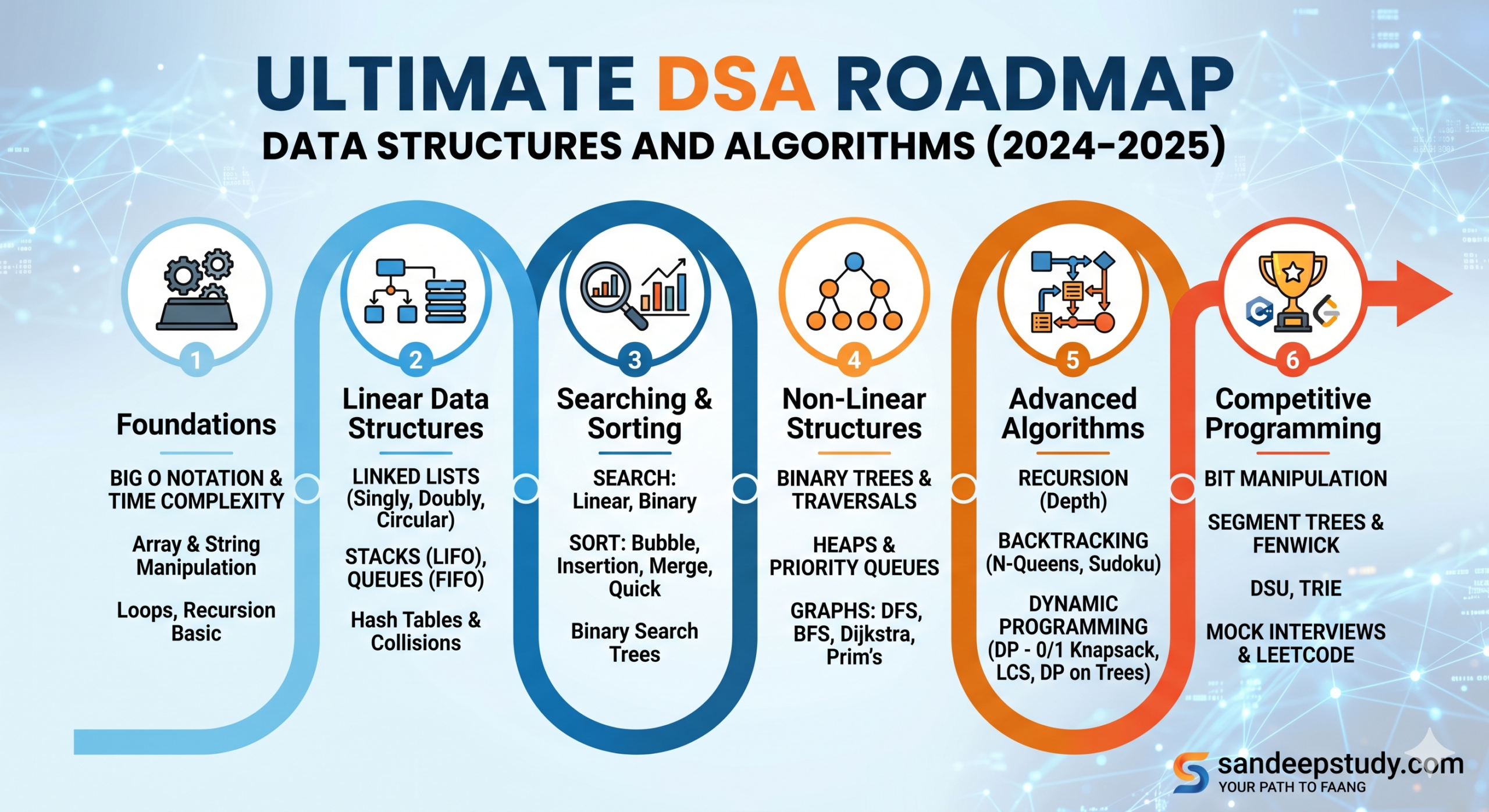
DSA Roadmap for Beginners — Complete Phase Wise Plan 26 Weeks
DSA Roadmap for Beginners mein sabse badi problem ye hoti hai ki beginners jaante nahi ki start kahaan se karein. Ye 26-week roadmap follow kar — agar consistently kaam kiya toh placement season tak poori taiyaari ho jaayegi.
Phase 1 — Foundation Build Karo — Week 1 to Week 4
Is phase mein seedha DSA topics mat pakdo. Pehle ye cheezein solid karo:
- Java basics — variables, data types, operators, loops, functions
- Object Oriented Programming — classes, objects, inheritance, polymorphism, encapsulation
- Time Complexity aur Space Complexity — Big O Notation basics — O(1), O(n), O(log n), O(n squared)
- Array basics — declare karna, traverse karna, insert karna, delete karna
- String manipulation — reverse, palindrome check, anagram, substring problems
Phase 2 — Core Data Structures — Week 5 to Week 10
- LinkedList — Singly Linked List, Doubly Linked List, Circular Linked List
- Stack — LIFO principle, push pop peek operations, implementation
- Queue — FIFO principle, Simple Queue, Circular Queue, Priority Queue
- HashMap aur HashSet — Java mein ye daily use hote hain real projects mein
- Binary Search — sorted arrays pe fast search — O(log n)
- Recursion — base case aur recursive case concept properly samjho
Phase 3 — Intermediate Level — Week 11 to Week 18
- Binary Tree aur Binary Search Tree — inorder, preorder, postorder traversal
- Heaps — Min Heap aur Max Heap — PriorityQueue in Java
- Sorting Algorithms — Bubble Sort, Selection Sort, Insertion Sort, Merge Sort, Quick Sort
- Two Pointer Technique aur Sliding Window — array aur string problems ke liye
- Graph basics — adjacency matrix, adjacency list, BFS, DFS
Phase 4 — Advanced Topics — Week 19 to Week 26
- Dynamic Programming — Memoization aur Tabulation approach dono
- Backtracking — N-Queens, Sudoku Solver, Rat in Maze type problems
- Greedy Algorithms — Activity Selection, Huffman Coding, Fractional Knapsack
- Advanced Graph Algorithms — Dijkstra, Bellman-Ford, Floyd Warshall, Kruskal, Prim
- Trie Data Structure — prefix search, autocomplete implementation
DSA Roadmap for Beginners — Java Code with Line by Line Comments
DSA Roadmap for Beginners mein code likhna theory se zyada important hai. Ye examples dekh — har line pe comment hai taaki kuch bhi confuse na ho:
Code 1 — Array Operations in Java
// ============================================================
// DSA Roadmap for Beginners — Phase 1 Topic: Array Basics
// Site: Sandeepstudy.com
// ============================================================

public class ArrayBasics {

    public static void main(String[] args) {

        // Array declare karo
        // int[] = integer type ka array
        // numbers = array ka naam
        // {10,20,30,40,50} = directly values assign karna
        int[] numbers = {10, 20, 30, 40, 50};

        // .length = Java ka built-in property — array ka size batata hai
        // ye method nahi hai — isliye parentheses nahi lagte
        int length = numbers.length;

        System.out.println("Array ki total length: " + length);
        // Output: Array ki total length: 5

        // for loop se array traverse karo — har element ek ek karke dekho
        // i = 0 se start — kyunki array ka pehla index 0 hota hai
        // i < length — last valid index 4 tak loop chalega
        // i++ — har iteration pe i ki value 1 se badhti hai
        for (int i = 0; i < length; i++) {

            // numbers[i] = i-th index pe jo value hai
            System.out.println("Index " + i + " pe value: " + numbers[i]);
        }
        // Output:
        // Index 0 pe value: 10
        // Index 1 pe value: 20
        // Index 2 pe value: 30
        // Index 3 pe value: 40
        // Index 4 pe value: 50

        // Maximum element dhundhna — classic DSA interview problem
        // pehle maan lo pehla element hi maximum hai
        int max = numbers[0];

        // index 1 se shuru karo — 0 already max mein store hai
        for (int i = 1; i < length; i++) {

            // agar current element pichle max se bada hai
            if (numbers[i] > max) {

                // toh max update karo naye bade element se
                max = numbers[i];
            }
        }

        System.out.println("Sabse bada element: " + max);
        // Output: Sabse bada element: 50

        // Linear Search — koi specific element dhundhna
        int target = 30; // ye dhundhna hai

        // found = track karega ki element mila ya nahi
        boolean found = false;

        for (int i = 0; i < length; i++) {

            // current element compare karo target se
            if (numbers[i] == target) {

                System.out.println(target + " mila index " + i + " pe");
                found = true; // flag true karo
                break; // loop rok do — kaam ho gaya
            }
        }

        // agar pura loop chala aur element nahi mila
        if (!found) {
            System.out.println(target + " array mein nahi hai");
        }
    }
}
Code 1 — Har Term Ka Explanation
- int[] — integer type ka array declare karne ka Java syntax
- .length — Java array ki built-in property jo array ka size return karta hai
- index — array mein position, hamesha 0 se shuru hoti hai
- for loop — fixed number of times koi operation repeat karna
- max variable — comparison ke liye current maximum temporarily store karta hai
- boolean found — true ya false track karne ke liye flag variable
- break — loop ko beech mein rokne ka keyword
- Linear Search Time Complexity — O(n) — worst case mein pura array dekhna padta hai
Code 2 — Stack Implementation with Real Use Case
// ============================================================
// DSA Roadmap for Beginners — Phase 2 Topic: Stack
// Real-life use: Text Editor ka Undo feature
// Site: Sandeepstudy.com
// ============================================================

import java.util.Stack;
// Java ka built-in Stack class import karo
// ye java.util package mein available hai

public class StackExample {

    public static void main(String[] args) {

        // Stack object banao — String type ka
        // Stack<String> = is stack mein sirf String values jayengi
        // undoStack = naam — undo history store karega
        Stack<String> undoStack = new Stack<>();

        // push() method = stack ke TOP pe element add karta hai
        // LIFO — Last In First Out principle follow karta hai
        undoStack.push("Typed: Hello World");
        // Stack: [Typed: Hello World]

        undoStack.push("Applied Bold Formatting");
        // Stack: [Typed: Hello World, Applied Bold Formatting]

        undoStack.push("Changed Font Size to 16");
        // Stack: [Typed: Hello World, Applied Bold Formatting, Changed Font Size to 16]

        System.out.println("Current Stack: " + undoStack);
        // Output: [Typed: Hello World, Applied Bold Formatting, Changed Font Size to 16]

        // User ne Ctrl+Z press kiya — Undo
        // pop() = TOP se element nikal deta hai aur return karta hai
        // LIFO — jo last add hua wo pehle niklega
        String lastAction = undoStack.pop();
        System.out.println("Undo hua: " + lastAction);
        // Output: Undo hua: Changed Font Size to 16

        // peek() = top element dekho — remove nahi karta
        // sirf current top kya hai ye jaanne ke liye
        String currentTop = undoStack.peek();
        System.out.println("Abhi top pe: " + currentTop);
        // Output: Abhi top pe: Applied Bold Formatting

        // isEmpty() = stack empty hai ya nahi — boolean return karta hai
        System.out.println("Stack empty hai: " + undoStack.isEmpty());
        // Output: Stack empty hai: false

        // size() = stack mein kitne elements hain abhi
        System.out.println("Stack size: " + undoStack.size());
        // Output: Stack size: 2
    }
}
Code 3 — HashMap in Java — Daily Real Project Use
// ============================================================
// DSA Roadmap for Beginners — Phase 2 Topic: HashMap
// Real-life use: Student marks store aur retrieve karna
// Site: Sandeepstudy.com
// ============================================================

import java.util.HashMap;
// HashMap class import karo — java.util package mein hai

import java.util.Map;
// Map interface import karo — forEach use karne ke liye

public class HashMapExample {

    public static void main(String[] args) {

        // HashMap banao
        // String = key ka type — student ka naam
        // Integer = value ka type — student ke marks
        HashMap<String, Integer> studentMarks = new HashMap<>();

        // put() = key-value pair add karta hai HashMap mein
        studentMarks.put("Rahul", 85);
        // "Rahul" = key, 85 = value

        studentMarks.put("Priya", 92);
        studentMarks.put("Amit", 78);
        studentMarks.put("Sneha", 95);

        // get() = key se value retrieve karo — average O(1) time mein
        int rahulMarks = studentMarks.get("Rahul");
        System.out.println("Rahul ke marks: " + rahulMarks);
        // Output: Rahul ke marks: 85

        // containsKey() = check karo key exist karti hai ya nahi
        boolean exists = studentMarks.containsKey("Amit");
        System.out.println("Amit exist karta hai: " + exists);
        // Output: Amit exist karta hai: true

        // size() = kitne key-value pairs hain total
        System.out.println("Total students: " + studentMarks.size());
        // Output: Total students: 4

        // entrySet() se pura map iterate karo
        // Map.Entry = ek key-value pair represent karta hai
        for (Map.Entry<String, Integer> entry : studentMarks.entrySet()) {
            // getKey() = key return karta hai
            // getValue() = value return karta hai
            System.out.println(entry.getKey() + ": " + entry.getValue() + " marks");
        }

        // remove() = key-value pair delete karo
        studentMarks.remove("Amit");
        System.out.println("Amit remove karne ke baad size: " + studentMarks.size());
        // Output: Amit remove karne ke baad size: 3
    }
}
DSA Roadmap for Beginners — Real Projects Mein Kahan Use Hota Hai
DSA Roadmap for Beginners sirf theory nahi hai — ye real projects mein roz use hota hai. Ye table dekh:
| Data Structure | Real World App | Java Implementation | Time Complexity |
| Array / ArrayList | E-commerce product listing | List<Product> in Spring Boot REST API | Access O(1), Search O(n) |
| HashMap | User session management | HashMap<String, User> for caching | Average O(1) all operations |
| Stack | VS Code Undo feature | Stack<String> action history | Push Pop Peek — O(1) |
| Queue | WhatsApp message delivery | LinkedList as Queue, RabbitMQ | Enqueue Dequeue — O(1) |
| Binary Search Tree | Database index lookup | TreeMap in Java — sorted keys | Average O(log n) |
| Graph | Zomato delivery route | Adjacency List using HashMap | BFS DFS — O(V plus E) |
| Trie | Google search suggestions | Custom Trie class implementation | O(length of word) |
| Heap / PriorityQueue | Uber driver matching | PriorityQueue in Java | Insert Extract — O(log n) |
DSA Roadmap for Beginners — Data Structures Comparison Table
| Data Structure | Access | Search | Insert | Delete | Best Use Case |
| Array | O(1) | O(n) | O(n) | O(n) | Fixed size, index-based fast access |
| LinkedList | O(n) | O(n) | O(1) at head | O(1) at head | Dynamic size, frequent insertions |
| Stack | O(n) | O(n) | O(1) | O(1) | LIFO operations, undo redo, browser back |
| Queue | O(n) | O(n) | O(1) | O(1) | FIFO operations, message queues, BFS |
| HashMap | O(1) avg | O(1) avg | O(1) avg | O(1) avg | Key-value lookup, caching, frequency count |
| Binary Search Tree | O(log n) avg | O(log n) avg | O(log n) avg | O(log n) avg | Sorted data, range queries |
| Heap | O(1) for min/max | O(n) | O(log n) | O(log n) | Priority-based processing, Dijkstra |
| Graph | O(1) | O(V+E) | O(1) | O(V+E) | Networks, routes, social connections |
DSA Roadmap for Beginners — Common Mistakes Jo Beginners Karte Hain
DSA Roadmap for Beginners follow karte waqt beginners kuch aise mistakes karte hain jo unki progress rok deti hain. Ye mistakes avoid karo:
Mistake 1 — Theory Padha, Code Nahi Likha
DSA YouTube pe dekhna aur books padhna alag hai — khud code likhna alag hai. Roz minimum ek problem khud solve karo. Solution pehle mat dekho — 30 minute khud try karo.
Mistake 2 — LeetCode Hard Problems se Shuru Karna
LeetCode Hard problems senior engineers ke liye hain. Freshers ke liye Easy se shuru karo, phir Medium, phir Hard. Sequence mat todo — confidence pehle build hoga tabhhi aage badh paoge.
Mistake 3 — Solution Copy Paste Karna Without Understanding
Solution dekh ke copy paste karne se kuch nahi seekhoge. Dekho, samjho, close karo, phir khud blank editor mein likho. Ye ek step bahut zyada difference karta hai.
Mistake 4 — Multiple Topics Ek Saath Jump Karna
Array chhod ke achanak Graph pe jump mat karo. DSA Roadmap for Beginners ka sequence follow karo — ek topic ka foundation strong hoga tabhhi next topic samjhega.
Mistake 5 — Time Complexity Ignore Karna
Interview mein sirf code kaam karna kaafi nahi hota. Interviewer poochhega — “Is solution ki time complexity kya hai, better approach hai kya?” Har solution ke saath Big O analysis karna seekho.
Mistake 6 — Mock Interviews Nahi Dena
Akele practice aur interviewer ke saamne explain karna bilkul alag experience hai. Dost ke saath mock interview do — ek interviewer bane, ek candidate. Bahut fark padta hai confidence mein.
Mistake 7 — Consistency Nahi Rakhna
Ek din 5 ghante DSA karna aur phir 3 din kuch nahi karna — ye approach kaam nahi karti. Roz 1 ghanta consistent practice karo — 6 mahine mein tujhe khud fark dikhega.
DSA Roadmap for Beginners — Top 10 Interview Questions with Answers
DSA Roadmap for Beginners ko interview ke liye ready karna chahte ho toh ye 10 questions aur answers yaad karo — exactly isi tarah answer karna hai:
Question 1 — What is Data Structure and why do we use it?
Yes sir, Data Structure ek organized way hai jisme hum data ko computer memory mein systematically store aur manage karte hain. Hum isiliye use karte hain kyunki organized data pe search, insert, delete jaise operations efficiently perform hote hain. Jaise library mein books alphabetically arranged hoti hain to koi bhi book jaldi milti hai — waise hi Data Structures data ko arrange karte hain taaki operations optimized rahein.
Question 2 — What is the difference between Array and LinkedList?
Yes sir, Array mein elements contiguous memory mein store hote hain aur index se direct access hota hai O(1) time mein. LinkedList mein nodes hote hain jo pointers se connected hote hain — access O(n) time leta hai kyunki head se traverse karna padta hai. Array ka size fixed hota hai, LinkedList dynamic hoti hai. Insertion aur deletion LinkedList mein head ya tail pe O(1) mein hoti hai, Array mein beech mein shifting lagti hai isliye O(n) hota hai.
Question 3 — What is Stack? Give a real-life example.
Yes sir, Stack ek LIFO — Last In First Out — data structure hai. Jo element last mein add hua wo pehle niklega. Java mein java.util.Stack class available hai. Real-life example hai text editor ka Undo feature — jab Ctrl+Z press karte hain toh last kiya gaya action pehle undo hota hai. Browser ka back button bhi Stack use karta hai — jo page last mein visit kiya wo back press karne pe pehle aata hai.
Question 4 — What is Queue? What are its types?
Yes sir, Queue ek FIFO — First In First Out — data structure hai. Jo element pehle add hua wo pehle niklega. Real-life example hai hospital mein patient token system. Types hain — Simple Queue, Circular Queue, Priority Queue, aur Double Ended Queue jo Deque kehte hain. Java mein Queue interface hai jise LinkedList ya ArrayDeque se implement karte hain. BFS algorithm bhi Queue use karta hai.
Question 5 — What is Big O Notation? Explain with examples.
Yes sir, Big O Notation ek mathematical notation hai jo algorithm ki performance describe karta hai — specifically worst case mein input size ke saath time ya space kaise badhta hai. O(1) matlab constant time — HashMap ka get operation. O(n) matlab linear time — linear search. O(n squared) matlab quadratic — bubble sort ka nested loop case. O(log n) matlab logarithmic — binary search mein har step pe problem half hoti hai. Big O se hum different algorithms compare karke better solution choose karte hain.
Question 6 — What is the difference between BFS and DFS?
Yes sir, BFS — Breadth First Search — graph ya tree ko level by level explore karta hai. Queue use karta hai. Shortest path dhundhne ke liye best hai. DFS — Depth First Search — ek path pe end tak jaata hai phir backtrack karta hai. Stack ya recursion use karta hai. Cycle detection, topological sort, maze solving mein useful hai. Dono ki time complexity O(V plus E) hai jahan V vertices hain aur E edges hain.
Question 7 — What is Dynamic Programming?
Yes sir, Dynamic Programming ek optimization technique hai jisme bade problem ko chhote subproblems mein todte hain, har subproblem ka result store karte hain — isse memoization ya tabulation kehte hain — taaki same subproblem dobara calculate na karna pade. Use karte hain jab overlapping subproblems aur optimal substructure ho. Classic examples hain Fibonacci series, 0/1 Knapsack problem, Longest Common Subsequence. DP ke bina ye problems exponential time lete hain, DP ke baad polynomial time mein solve hote hain.
Question 8 — What is Binary Search? What is its time complexity?
Yes sir, Binary Search ek efficient searching algorithm hai jo sirf sorted arrays pe kaam karta hai. Ye middle element se compare karta hai — agar target middle se chhota hai toh left half mein search karo, bada hai toh right half mein. Har step mein search space half hoti jaati hai. Time complexity O(log n) hai jo linear search ke O(n) se bahut better hai — 1 million elements mein linear search worst case 1 million steps, binary search sirf 20 steps mein answer deta hai.
Question 9 — What is Recursion? What is base case?
Yes sir, Recursion wo technique hai jisme function apne aap ko call karta hai kisi problem ke chhote version ke saath. Base case wo condition hai jahan function khud ko call karna band kar deta hai — bina base case ke stack overflow ho jaayega. Example hai Factorial — factorial of 5 equals 5 times factorial of 4, ye tab tak chalega jab tak factorial of 0 equals 1 base case pe pahunche. Tree traversal, Graph DFS, Divide and Conquer, Backtracking — sab recursion pe based hain.
Question 10 — How to find duplicates in an array? Most efficient approach?
Yes sir, teen approaches hain. Pehla — Brute Force — nested loops se har element baaki sab se compare karo — O(n squared) time, O(1) space. Doosra — Sorting — array sort karo phir adjacent elements compare karo — O(n log n) time, O(1) space. Teesra aur most efficient — HashSet approach — ek ek element HashSet mein add karo, agar add nahi hua matlab duplicate hai — O(n) time, O(n) space. Interview mein HashSet approach choose karunga aur time-space trade-off bhi explain karunga.
DSA Roadmap for Beginners — Output Prediction Practice
DSA Roadmap for Beginners mein output prediction questions bhi important hain — interview mein aksar aisa poochha jaata hai. Ye code dekh aur output predict karo:
import java.util.Stack;

public class PredictOutput {
    public static void main(String[] args) {
        Stack<Integer> s = new Stack<>();
        s.push(5);     // Stack: [5]
        s.push(10);    // Stack: [5, 10]
        s.push(15);    // Stack: [5, 10, 15]
        System.out.println(s.pop());     // Line A — kya aayega?
        System.out.println(s.peek());    // Line B — kya aayega?
        s.push(20);    // Stack: [5, 10, 20]
        System.out.println(s.size());    // Line C — kya aayega?
        System.out.println(s.isEmpty()); // Line D — kya aayega?
    }
}
Answers:
- Line A — 15 — LIFO principle, 15 last push hua tha isliye pehle niklega
- Line B — 10 — peek top element return karta hai bina remove kiye, ab top pe 10 hai
- Line C — 3 — stack mein 5, 10, 20 hain — size 3 hai
- Line D — false — stack mein 3 elements hain, empty nahi hai
DSA Roadmap for Beginners — Quick Revision Summary
- DSA Roadmap for Beginners ka matlab hai Data Structures aur Algorithms ko structured plan ke saath seekhna
- DSA Roadmap for Beginners 2026 mein placement ke liye compulsory hai — Amazon se Indian startups tak sab coding round lete hain
- Phase 1 — Foundation: Java basics, Big O Notation, Arrays, Strings — Week 1 to 4
- Phase 2 — Core: LinkedList, Stack, Queue, HashMap, Binary Search, Recursion — Week 5 to 10
- Phase 3 — Intermediate: Trees, Heaps, Sorting, Graphs, Two Pointer — Week 11 to 18
- Phase 4 — Advanced: DP, Backtracking, Greedy, Advanced Graphs, Trie — Week 19 to 26
- Stack — LIFO — push pop peek — O(1) — real use: undo feature, browser back button
- Queue — FIFO — enqueue dequeue — O(1) — real use: message delivery, BFS
- HashMap — Key-value store — O(1) average — real use: caching, session management
- Binary Search — O(log n) — sirf sorted arrays pe — bahut faster than linear search
- Roz minimum 1 problem khud solve karo — consistency is the real key
- LeetCode Easy se shuru karo, phir Medium, phir Hard — sequence mat todo
- Har solution ke saath time complexity aur space complexity analyze karo
- Mock interviews dena — akela practice aur live interview mein bahut fark hota hai
- DSA Roadmap for Beginners follow karne wale students consistently practice se hi aage jaate hain
DSA Roadmap for Beginners — Helpful External Resources
DSA Roadmap for Beginners ko aur strong banane ke liye ye trusted resources regularly use karo:
- LeetCode Problems — DSA practice ke liye India ka sabse popular platform
- GeeksforGeeks Data Structures — theory, examples aur Java code ke saath
- Java Official Documentation — Collections Framework complete reference
DSA Roadmap for Beginners — Read Next on Sandeepstudy.com
DSA Roadmap for Beginners ke saath in topics ko bhi padho — placement preparation complete hogi:
- Java Collections Framework Complete Guide — ArrayList vs LinkedList vs HashMap
- Top 50 Java Interview Questions and Answers for Freshers 2026
- Spring Boot Beginner Roadmap — Zero to REST API Step by Step
- Recursion Complete Guide in Java — Base Case, Call Stack, aur Backtracking
Conclusion — DSA Roadmap for Beginners Ko Aaj Se Shuru Karo
DSA Roadmap for Beginners sunne mein bada lagta hai — 26 weeks ka plan, itne sare topics, itna code. Lekin yaar, main tujhe ek baat clearly bolna chahta hoon jo main har junior ko bolta hoon — ye roadmap teri bakwaas karane ke liye nahi hai, ye teri placement guarantee karne ke liye hai agar consistently follow kare.
Har successful developer ne ek waqt pe wahi jagah se shuru kiya jahan tu abhi khada hai — zero se. Fark ye hai ki wo ruka nahi. Jab koi problem samajh nahi aayi, toh dubara padha. Jab code nahi chala, toh debug kiya. Jab interview nahi hua, toh agle ki taiyaari ki.
DSA Roadmap for Beginners ka sab kuch ek raat mein clear nahi hoga — aur hona bhi nahi chahiye. Roz ek chota step lo. Aaj ek array problem solve karo. Kal Stack implement karo. Parso Binary Search khud likho. Ye chhote chhote steps milke tujhe placement-ready banayenge.
DSA Roadmap for Beginners follow karne wale consistent students ko results milte hain — ye proven hai. 2026 mein wo placement teri hai — bas consistently kaam karna hai aur DSA Roadmap for Beginners ka har phase seriously lena hai.
Sandeepstudy.com pe aate raho — hum har week naye detailed Hinglish guides laate hain Java, Spring Boot, DSA, aur placement preparation ke liye. Is article ko apne dosto ke saath share karo jo placement ki taiyaari kar rahe hain. Newsletter subscribe karo taaki next article seedha inbox mein mile.
Thank you for staying connected with Sandeepstudy.com — keep learning and growing